
Choosing the correct thickness for a concrete slab is one of the most important decisions when planning a shed, garage or patio. Whether installing concrete slabs in Hunter Valley for a residential outdoor area, storage shed or vehicle garage, the slab should be designed to suit its intended use, site conditions and expected loads. Hunter and Coast Concrete Pumping understands the importance of matching slab specifications to the demands of each project.
This article discusses the factors that influence slab thickness. It also outlines common thickness ranges for patios, sheds and garages, helping property owners understand when standard specifications may be suitable and when additional strength, reinforcement or engineering advice may be required.
The right slab thickness is never one-size-fits-all. It depends on what will sit on the concrete, how often the area will be used and what sort of loads the slab must support. Getting this wrong can increase the risk of cracking, movement or premature deterioration.
A light garden shed used for storage has different requirements from a double garage carrying vehicles or a patio supporting outdoor kitchens and furniture. Slab thickness is chosen to help distribute loads into the ground and provide a suitable base for the intended use. Soil conditions, drainage, reinforcement and site preparation are just as important as the slab depth itself.
The loads placed on a slab are one of the main factors that influence thickness. Slabs that carry only people and light furniture can often be thinner than slabs that support vehicles, machinery or heavy stored items.
For a patio or outdoor entertaining area, the main loads are usually people, tables, barbeques and outdoor furniture. These loads are relatively light and spread out, so a standard residential slab can often perform well when placed on a well-prepared base.
A shed slab must support the structure itself, as well as whatever is stored inside. A small garden shed with tools and bikes creates relatively low loads. However, a shed used for ride-on mowers, compressors, stacked materials or small machinery may need a thicker slab, stronger reinforcement or additional footing support.
Garages carry higher loads in most residential settings. Vehicle weight, tyre contact points and repeated traffic all place stress on the slab. Larger vehicles, caravans, trailers or vehicle hoists can increase these loads further. For this reason, garage slabs often need stronger reinforcement and may require thicker sections in high-load areas.
How often the slab is used also affects the design. A rarely used storage shed with mostly static loads may not need the same slab specification as a workshop where machinery, trolleys and people move around every day.
Garages used daily place repeated stress on the same wheel paths. Over time, this cycle of loading and unloading can contribute to cracking if the slab is not designed correctly. Thickness, reinforcement, base preparation and curing all work together to help the slab withstand regular vehicle use.
For patios, the load is usually more static and widely distributed. In many cases, good base preparation, suitable reinforcement, correct falls and control joints are just as important as increasing thickness.
Even when two slabs are used for the same purpose, they may need different specifications depending on the site. Reactive soils, poorly compacted ground, fill, sloping sites or areas with drainage issues can all increase the risk of slab movement.
A thicker slab with appropriate reinforcement may help manage minor movement, but it cannot compensate for poor ground preparation. The subgrade should be stable, compacted and suitable for the load it will carry.
Outdoor slabs also expand and contract with temperature changes. Correct joint placement, suitable thickness and proper curing help reduce the risk of uncontrolled cracking, particularly on larger patios, driveways and garage slabs.
Patio slabs do not usually carry the same heavy loads as garages or workshops, but they still need enough strength and support to avoid cracking, lifting or becoming uneven. Getting the slab design right at the start is far easier than repairing a failed outdoor slab later.
For many residential patios and outdoor entertaining areas, a 100 mm concrete slab with light reinforcement is commonly used. However, thicker slabs or additional reinforcement may be needed where the patio will carry heavier features, sit on poor ground or be exposed to occasional vehicle loads.
For a typical ground-level patio used for foot traffic and outdoor furniture, a 100 mm slab is often suitable when the ground is properly prepared and the slab is reinforced.
Situations that may justify increasing the thickness to around 125–150 mm include:
Slab thickness should be consistent across the main patio area. Edges that taper too thin are more vulnerable to cracking, chipping and settlement.
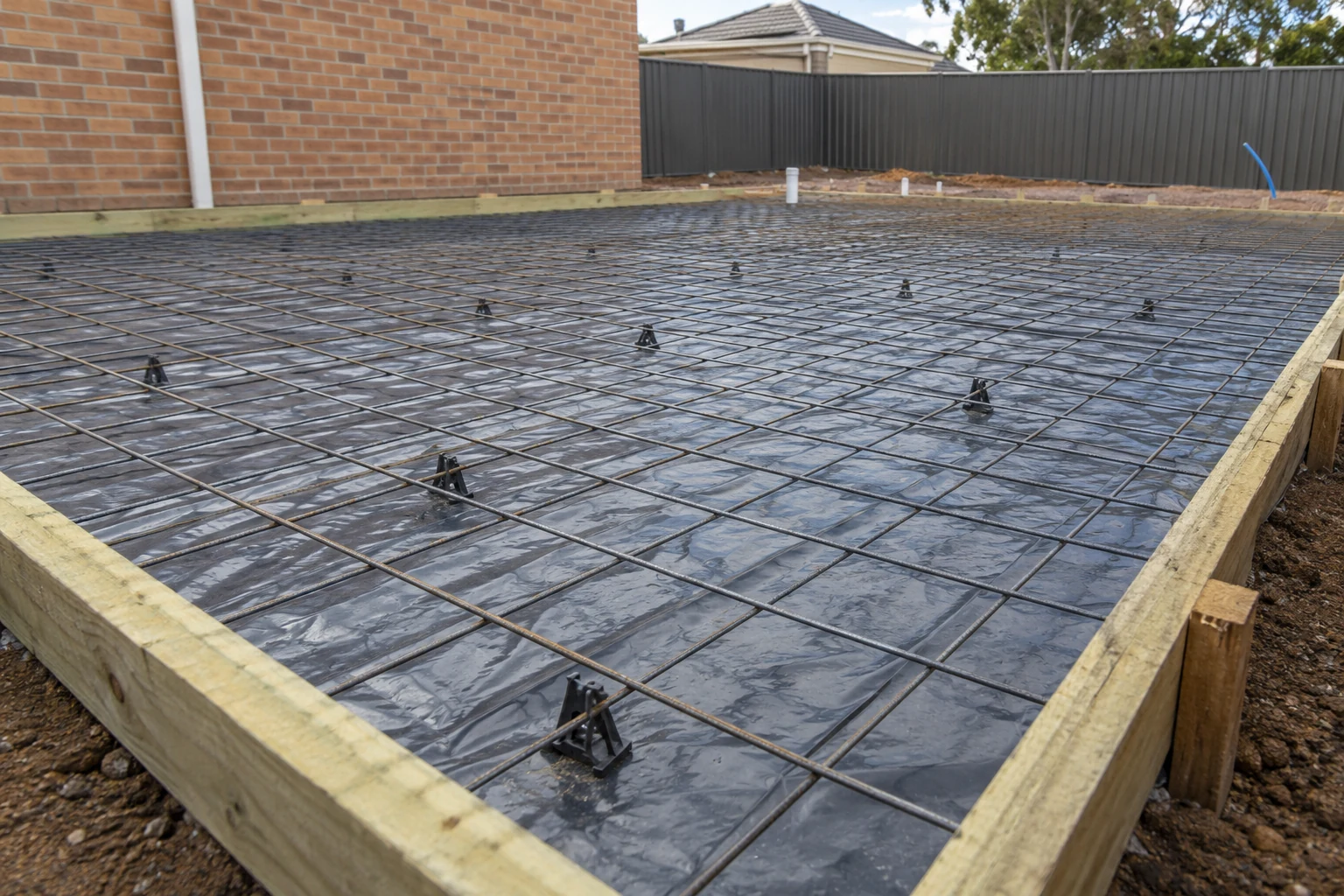
Reinforcement mesh is commonly recommended for outdoor slabs, even where the loads are relatively light. Mesh helps control shrinkage cracking and can hold fine cracks tighter so the surface remains more serviceable.
For patios, SL72 mesh on bar chairs is a common example, but the final reinforcement should depend on the slab size, soil conditions and intended use. The mesh must be properly positioned within the concrete to be effective.
Control joints are also important in outdoor areas exposed to sun and weather. Saw-cut joints are often spaced at regular intervals to encourage concrete to crack in controlled locations rather than randomly across the slab. The exact spacing and depth should be based on slab thickness, layout and site conditions.
Patio edges that will support garden walls, privacy screens, steps or heavier edge loads may benefit from a thickened edge beam. This can provide better support and help reduce cracking along exposed or unsupported edges.
Correct site preparation is just as important as slab thickness. Topsoil, organic material and soft ground should be removed before the subgrade is compacted. A layer of compacted road base or crushed rock is commonly used to create a stable, even base beneath the slab.
Drainage also needs to be considered. Outdoor slabs should generally fall away from the house so water does not pond on the surface or sit against the building. Poor drainage can contribute to movement, staining, surface deterioration and moisture problems around adjoining structures.
For exposed patios, a textured or broom finish can improve slip resistance, particularly when wet. Decorative finishes can still require the same structural preparation as standard concrete, even if the finished surface looks more like paving or stone.
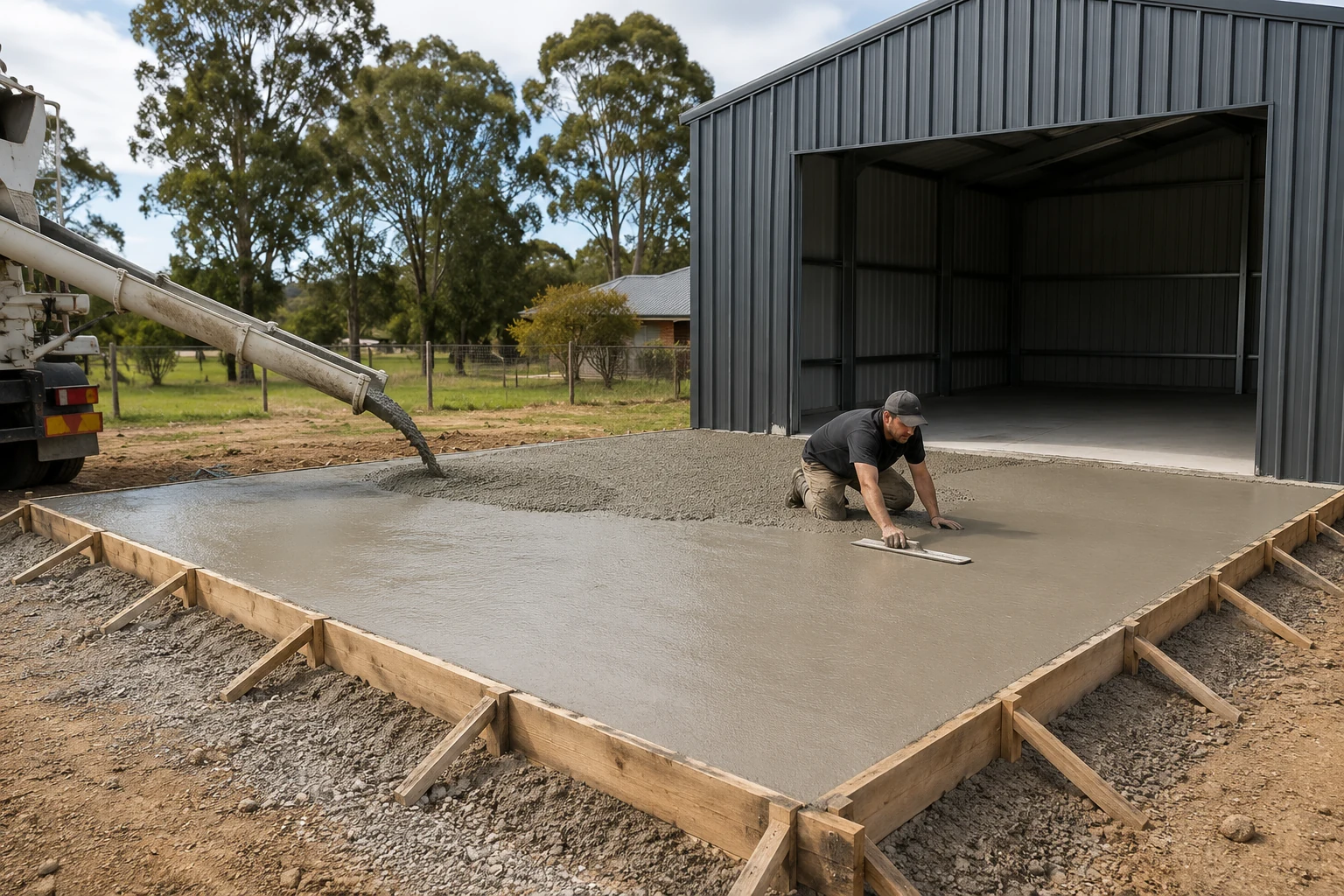
Concrete slabs for sheds and garages must be thick enough to support the building, storage loads and vehicle traffic without excessive cracking or settlement. A correctly designed slab also helps prevent door alignment issues, moisture problems and movement around the structure.
Although site conditions vary, there are practical thickness ranges that suit many backyard sheds and domestic garages, provided the base is well prepared and the slab is properly reinforced.
For light domestic sheds used for garden tools, bikes or small equipment, a 100 mm slab is commonly used when placed on a compacted base with suitable reinforcement. This can provide adequate support for many low-load residential uses.
For larger steel sheds, workshops or hobby spaces, 100 mm may still be common, but the reinforcement, base quality and edge details become more important. Where heavier equipment, ride-on mowers, small trailers or stacked materials will be stored, a thicker slab or additional reinforcement may be required.
Heavier rural, commercial or industrial sheds may require 125 mm or more, depending on the expected loads. In these cases, slab design should be checked against the actual use rather than relying on a general domestic thickness.
Single and double domestic garages that carry passenger vehicles commonly use a 100 mm reinforced slab on a compacted subgrade. This can be suitable for cars, SUVs and light utes when the slab is properly designed, supported and cured.
Where heavier vehicles, caravans, small trucks or vehicle hoists are planned, a thicker slab is usually required. In many situations, 125 mm with heavier reinforcement may be a more appropriate starting point. Vehicle hoists, jacks and other concentrated point loads should always be checked against the equipment manufacturer’s requirements.
Garage slabs may also benefit from thickened edges at garage door openings and around perimeter walls. These areas can experience repeated loading, weather exposure and point stress from doors, frames or fixings.
Slab thickness alone cannot overcome poor ground preparation. A shed or garage slab should be placed on a level, compacted base, often with a layer of road base or compacted gravel to provide support and assist drainage.
Reinforcement mesh is commonly used for shed and garage slabs. Correct steel cover, lap lengths and support on bar chairs are essential so the mesh sits in the right position within the slab. If mesh is placed directly on the ground or pushed too low during the pour, it will not control cracking as effectively.
In more heavily loaded garages, workshops or large sheds, additional reinforcing bars, thicker sections, edge beams or isolated pads may be needed to suit the expected load.
Concrete slab thickness is only one part of slab performance. Reinforcement helps the slab manage cracking, distribute loads and cope with movement. For sheds, garages and patios that carry heavier loads or sit on less stable ground, reinforcement can be the difference between a slab that performs well and one that cracks prematurely.
Additional reinforcement does not always mean the whole slab must be thicker. In some cases, the best solution is to keep the main slab thickness appropriate for the use while adding steel mesh, reinforcing bars, thickened edges or localised pads where extra strength is needed.
Any slab supporting more than foot traffic should be assessed carefully. Reinforcement is especially important for:
A typical double garage slab may commonly be around 100 mm thick, but thickness alone is not enough for long-term performance. Reinforcing mesh helps control cracking and spread loads from tyres, stands and stored items.
For heavier applications, an engineer may specify a thicker slab, stronger mesh or reinforcing bars in high-stress zones.
Problematic ground is one of the most common reasons for additional reinforcement. On sloping sites, reinforcement can help the slab act more as a single unit and reduce the risk of cracking where the subgrade changes from cut to fill.
Reactive clay soils can swell and shrink as moisture levels change. This movement places stress on concrete and may require a more detailed slab design. In these conditions, reinforcement is often combined with:
For patios, paths and shed slabs on reactive soils, mesh reinforcement is commonly recommended even when the slab itself is not especially thick.
Even on good ground, reinforcement may be needed where appearance, durability or structural support is important.
Patios that will be tiled or finished with decorative coatings often benefit from reinforcement because it can help limit crack width. Fine hairline cracks are common in concrete, but uncontrolled cracks can become more visible beneath tiles, coatings or polished finishes.
Slabs supporting walls, posts, shed frames or brickwork need additional consideration. Any point where a frame bolts into the slab creates a concentrated stress point. Thickened footings, pads or reinforcing bars under columns and posts may be required to provide adequate support.
Where a slab connects to an existing house, retaining wall or other structure, dowels or isolation joints may be needed depending on whether the slab should move independently or be tied into the adjoining structure.
Selecting the right slab thickness is essential for achieving a durable, long-lasting result. Many patios, sheds and residential garages can be built successfully with a 100 mm reinforced slab, but heavier loads, reactive soils, poor ground conditions and specialised applications may require increased thickness, additional reinforcement or an engineered design.
The best slab specification depends on more than thickness alone. Base preparation, reinforcement, drainage, joint placement, curing and site conditions all influence how well the finished slab performs. By assessing the specific requirements of the project before construction begins, property owners can reduce the risk of cracking, settlement and premature failure.